
Find Content
Evaluating Porcelain Insulator Designs for Seismic Testing
Pre-testing insulators as a cost-effective qualification strategy before shaker table testing


Key Takeaways
| MFL 12.2 kN | ||
| Applied force kN | Percentage of rating, % | Cycles, 4 quadrants |
| 7.3 | 59.8 | 10 |
| 12.2 | 100.0 | 1 |
| 8.5 | 69.7 | 1 |
| 10.0 | 82.0 | 1 |
| 7.3 | 59.8 | 1 |
| 10.0 | 82.0 | 1 |
| 7.3 | 59.8 | 2 |
Abstract
Insulators subjected to shaker table testing will see hundreds of bending loads ranging from very low values to the full yield rating. Past studies explored cycle loading at a set magnitude, applied in one direction. This project dives deeper into load magnitude variation and load direction more closely reflected in shaker table tests.
Past shaker table test results were reviewed to quantify the number of loads, load magnitudes and load directions. A set of insulators with a history of seismic-region applications was subjected to loads that mimic those found in typical shaker table testing. Deterioration of the set was measured by taking the insulators to their ultimate yield level and comparing the results to the benchmark group.
Introduction
Porcelain insulators have been used in seismic regions due to porcelain’s stiff material properties. Although porcelain is brittle, it has minimal deformation under load. Porcelain is also elastic for short duration loads up to yield, and static loads to 70% of yield values.
In seismic regions, porcelain insulators are the preferred technology for switch manufacturers. The switch designs are tested on shaker tables to simulate an earthquake. In the USA, IEEE 693 is the prevailing test standard.
Testing per IEEE 693 on a shaker table is quite expensive, typically costing more than $250 k USD. It
is important to use properly designed, high-quality insulators.
Understanding loads during shaker table testing
Although insulators are subjected to many forces during shaker table testing, a) Cantilever or Bending, b) Compression, c) Tension and d) Torsion, bending is the most demanding.
Further, bending loads during shaker table tests are very different from those performed as destructive sample tests that determine ultimate strength. Factory bending yield tests are applied slowly in one direction until fracture.
Though this method allows manufacturers to track average strength and standard deviation, it does not represent typical loads.
For example, if an insulator was loaded to 80% of average yield and held, a crack would eventually propagate and yield. This may take hours or even days. The closer the load is to the average bending yield strength, the quicker the yield will occur.
Another example more closely aligned with this study is rocking the insulator in opposite directions.
Shaker table testing goes further, by inducing motion in the X, Y and Z directions. The Y direction, up and down, is of little concern due to the insulator’s high compressive and tensile strength.
The X and Z loads produce rocking motion perpendicular to each other. Much like when one wants to pull a stake or post from the ground, rocking the post in all directions greatly loosens the bond between the soil and post.
Modes of yield on porcelain insulators
There are two main yield modes porcelain insulators can succumb to. A porcelain insulator consists of the porcelain body and cemented metal fittings. Each has characteristics that must be understood.
Porcelain
Porcelain itself will always yield at minor defects that are randomly dispersed throughout the body. The bending moment stress is highest at the bottom, as can be seen in Fig. 1 below.
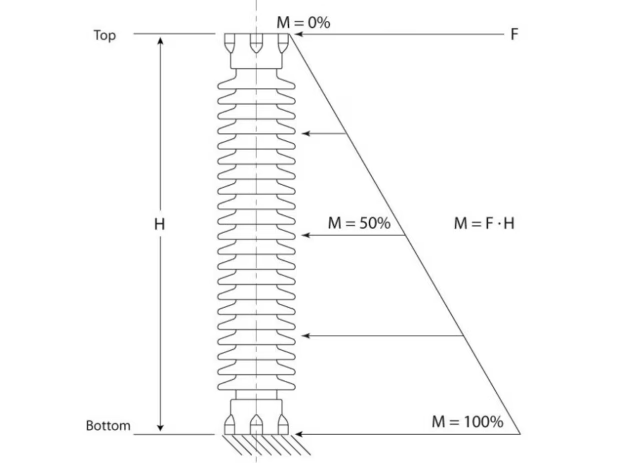
Fig. 1: Bending Moment. Source: PPC Insulators.
Factory sample tests are applied in only one direction and one end and are less likely to encounter a small defect. On the other hand, during shaker table testing, all four quadrants, top and bottom, will be subject to high stress and are more likely to meet a defect.
As noted above, porcelain is elastic and can be repeatedly stressed in bending just below the yield level.
Fitting attachment
The metal fittings are bonded to the porcelain by Portland cement. Both the metal fitting and the porcelain at the attachment zone have features to aid in the bond. The fittings have saw teeth ribs along the inner diameter, and the porcelain has a sand band.
The strength of the bond is dependent on the porcelain’s length of engagement, diameter of the joint and the controlled cement layer.
Larger engagement and diameters increase strength.
The ideal range for cement thickness is 5-7mm. Anything less than this makes the cement difficult to completely fill the void. When in excess of 7mm, the cement can shear midway between the metal fitting and the porcelain.
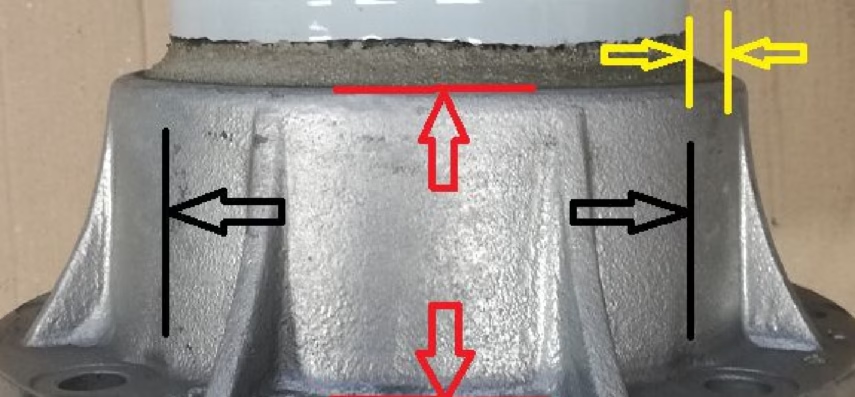
Fig. 2: Fitting strength parameters. Source: PPC Insulators.
The fitting remains elastic to 60% of yield levels. Above this, degradation begins to allow movement.
In both seismic events and shaker table testing, forces near yield levels, applied from opposite directions, cause rocking motion. In the early stages, the motion is nearly undetectable to the naked eye.
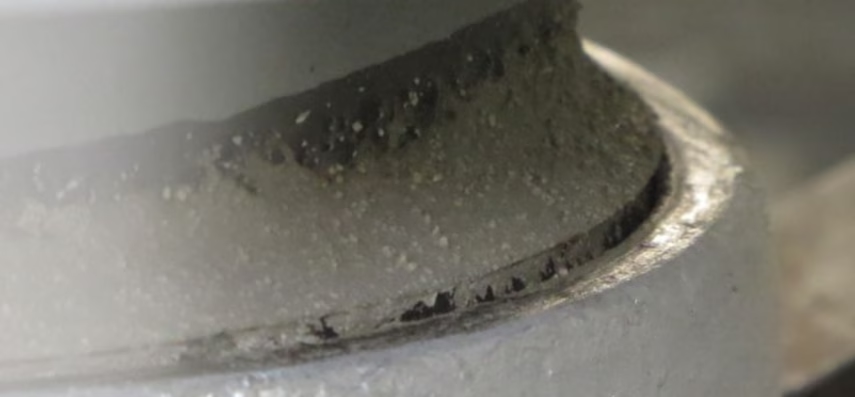
Fig. 4: Damaged cement joint. Source: PPC Insulators.
After many bidirectional loads, the displacement shows that the Portland cement has sheared, and is no longer providing an even load distribution.
Designs for seismic applications require special attention to the bond strength of the fittings. The goal is to create a fitting bond that exceeds the porcelain strength. This, in turn, results in a more elastic joint required in cyclic loading.
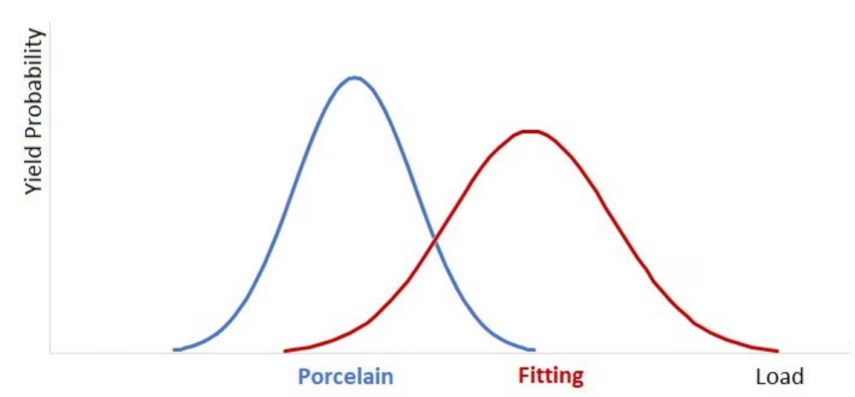
Fig. 5: Strength rating of components. Source: PPC Insulators.
Shaker table test data
Strain gages are applied to each support insulator in all four quadrants. The load data collection system is calibrated by applying test loads.
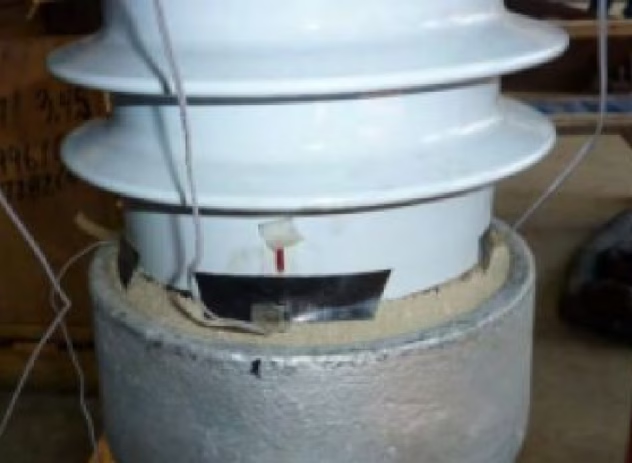
Fig. 6: Strain gage placement. Source: PPC Insulators.
Reviewing load graphs from previous shaker table testing, we see the magnitudes of the loads, the orientations of the largest loads, and the quantities of each. The graph depicts loads collected over a 45-second period.
In the graph below, bending loads were recorded at the maximum allowed per IEEE 693 performance-level testing, to full yield level rating. Approximately 16 loads were found at or above 60% of the rated yield level.
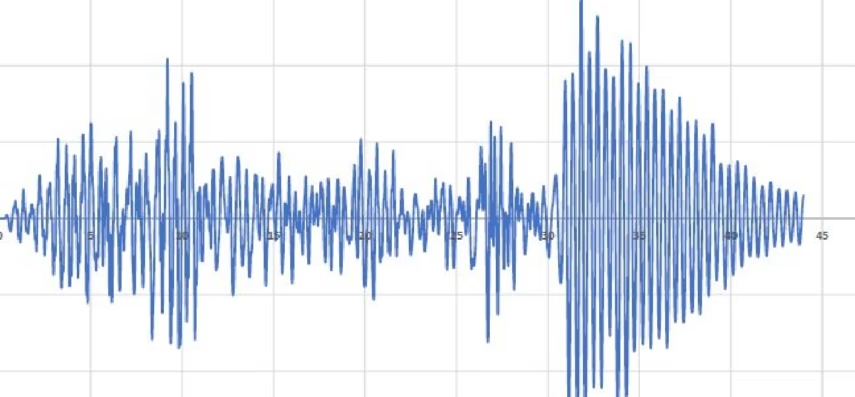
Fig. 7: Load Graph from Shaker table test. Source: PPC Insulators.
During the shaker table testing, insulators are subjected to the highest bending loads from horizontal forces perpendicular to the switch.
Loads parallel to the switch have the stiffening of two supports and, in some cases, one rotating stack.
Simulating loads encountered in shaker table tests
As mentioned, shaker table testing is expensive. Subjecting an insulator to the anticipated test loads beforehand can help build confidence prior to laboratory testing.
In the pretest load sequence, the worst-case scenario was assumed. Loads below 60% of yield are elastic and cause no damage. During the 45-second event, 107 oscillations were observed. The frequency was 2.37 cycles per second. Only 16 were above the 60% of yield level. In the qualification run, only loads above 60% of the yield rating were used.
Typical factory load rates are far slower than the natural vibrations seismic events bring. Longer duration loads result in more damage.
Test plan
To establish a benchmark, historical bending data was collected. A group of 86 test results were used to determine the average yield level and the standard deviation.
Ten test samples, matching the benchmark group’s design, were selected for testing.
To simulate shaker table load inputs, loads were applied in the +X/-X and +Z/-Z. The Y-axis was ignored because the compression loads were low relative to the insulator’s high capabilities.
The loads and their levels were applied based on an actual graph collected during a shaker table test.
The graph begins with moderate oscillations reaching 60% of the rating. The middle phase resulted in loads of less than 50% of the rating. The final phase erupts to 100%
rating loads, then exhibits a declining amplitude. This last phase is where the majority of the high bending loads were found.
Loads were applied in all four quadrants by rotating the insulator. After all the samples were subjected to the bending series, they were taken to their ultimate strength.
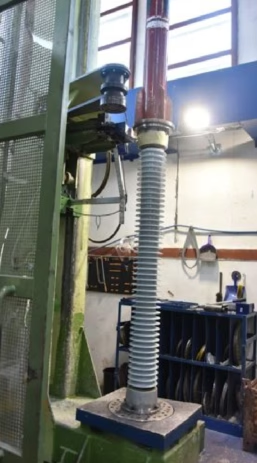
Fig. 8: Test cell. Source: PPC Insulators.
The test series was established as follows.
Table 1: Load series for the test lot. Source: PPC Insulators.
Results summary
| Benchmark group, 86 samples | |
| Average breaking strength | 17.3 kN |
| Median | 17.5 kN |
| Standard deviation | 1.72 kN |
Table 2: Benchmark group results. Source: PPC Insulators.
| Test group, 10 samples | |
| Average breaking strength | 17.3 kN |
| Median | 18.19 kN |
| Standard deviation | 1.91 kN |
Table 3: Test group results. Source: PPC Insulators.
Conclusions
Ten insulators were subjected to loads typically found in the IEEE 693 performance-level test. Quantity and load amplitudes were taken from an actual load graph from a shaker table test. Each cycle consisted of +/- in both the X and Z axes.
The yield data was compared between the benchmark group and the test group. The results were nearly identical, indicating that the cycles of loading did not cause deterioration in the test samples prior to ultimate yield testing.
The pretest assured that the future seismic shaker table testing would very likely pass.