

Find Content
RTV-coated ceramic post insulators for HVDC reactors: what the qualification data shows
What engineers and decision makers can learn from the paper: ‘Manufacturing and qualifying RTV-coated ceramic post insulators for a 400 kV HVDC air-core dry-type reactor project’. Plus download the full paper. This paper was presented by ITG/Trench Austria/PPC Insulators at the 2025 INMR World Congress, Panama City, Panama.
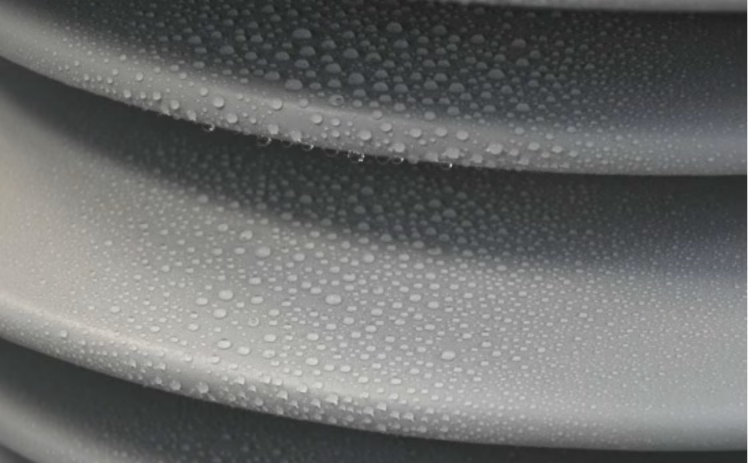
What the study found about RTV-coated porelain post insulators for HVDC reactors
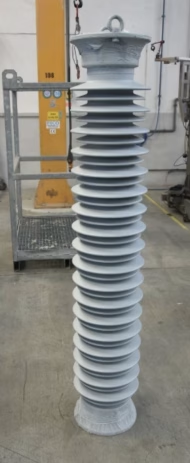
Manufacturing and qualifying RTV-coated C8-2550 ceramic post insulator for HVDC air-core dry-type reactors
Authors
- Markku Ruokanen
Quality and R&D Director, Insulator Technology Group (ITG) - Radoslav Strenk
Electrical Engineer, Insulator Technology Group (ITG) - Klaus Pointner
Research and Development/Senior Expert Coils and Systems, Trench Austria GmbH
What’s inside?
This paper documents how an isostatically-pressed, RTV-coated C8-2550 post insulator was manufactured and qualified for a real 500 kV subsea HVDC link. It raises a question about whether some of the standard coating characterization tests actually tell you anything useful.
The paper covers:
1. Context/problem: why HVDC links need bigger, more pollution-resistant post insulators
2. The product: the RTV-coated C8-2550 ceramic post insulator built for a 500 kV subsea HVDC project
3. Manufacturing process: isostatic pressing plus the three-layer RTV coating process
4. Qualification testing: mechanical/electrical type tests plus RTV-specific coating tests
5. A critical point on the ‘fingerprint’ tests: authors question the value of TGA/DSC/FTIR/density testing, flagging the draft IEC TS 63432 direction
6. Standards outlook: no finished standard yet; qualification is currently negotiated project-by-project
“Expect procurement and qualification discussions to start referencing IEC TS 63432 once it’s finalized, and factor that timeline into upcoming HVDC procurement”
What it tells engineers
Mechanical and electrical type testing followed IEC 60168 as standard practice. The real substance of this paper is the RTV coating qualification path, which isn’t governed by a finished standard yet – IEC TS 63432 is still circulating in draft and should be released soon.
On this project, acceptance criteria for thickness, adhesion, hydrophobicity and homogeneity were set by direct agreement between customer and manufacturer, not pulled from an existing spec.
What to do in practice
- When specifying RTV-coated insulators now, agree thickness, adhesion and homogeneity acceptance criteria directly with the manufacturer rather than assuming a standard covers it
- Treat TGA, DSC, FTIR and density reports on the coating material as informational rather than pass/fail evidence, in line with where IEC TC/36 is heading
- Ask whether coating is being applied factory-side or in the field – factory application gave this project tighter, more consistent thickness control
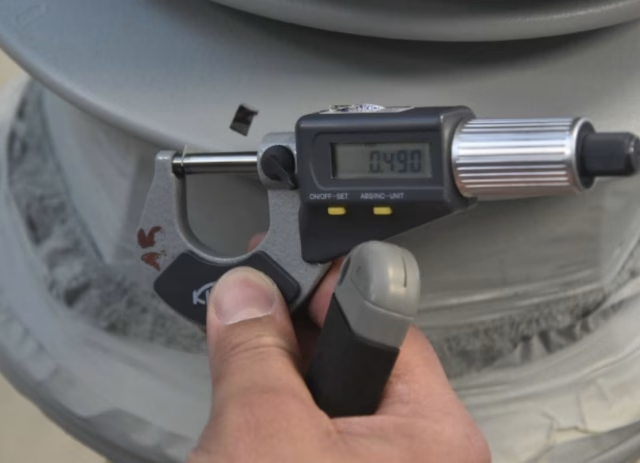
What it tells decision makers
There’s no finished standard yet for qualifying RTV-coated ceramic post insulators. IEC TS 63432 is out for comment now, and its likely direction – moving several characterization tests to ‘for information only’ – will reshape what factory acceptance testing looks like once it’s adopted.
In the meantime, qualification on projects like this one is being negotiated project by project between manufacturer and customer.
What to do in practice
- Expect procurement and qualification discussions to start referencing IEC TS 63432 once it’s finalized – factor that timeline into upcoming HVDC procurement
- Budget for factory-applied RTV coating over field coating where pollution performance and creepage distance are critical – it avoids the cost and complexity of de-energizing a line for on-site work
To sum up: factory-applied RTV coating is superior
This project confirmed that factory-applied RTV coating offers significant advantages over field-applied coating. The controlled factory environment ensures excellent adhesion and homogenous thickness, which are guarantees for a long lifetime.
In contrast, on-site coating is susceptible to dust and rain, more expensive due to substation de-energization, and results in more thickness variation.
The new Technical Specification IEC TS 63432 will reinforce the tendency to use factory-coated ceramic insulators for HVDC applications where high rigidity and pollution performance are required.
Want to hear insulator new, insights and paper summaries as soon as we release them? Sign up to receive IEI updates
References
IEC CD 63432: RTV silicone rubber-coated insulators for AC and DC high-voltage applications – definitions, test methods and acceptance criteria, date of circulation July 11, 2025
IEC 60168:1994 Ed. 4.0: Tests on indoor and outdoor post insulators of ceramic material or glass for systems with nominal voltages greater than 1000 V
EN ISO 11358-1:2022 Ed. 2.0: Plastics – Thermogravimetry (TG) of polymers – Part 1: General principles
EN ISO 11357-2:2022 Ed. 3.0: Plastics – Differential scanning calorimetry (DSC) – Part 2: Determination of glass transition temperature and step height
EN 1767:1999: Products and systems for the protection and repair of concrete structures – Test methods – Infrared analysis
ISO 2781:2018 Ed. 5.0: Rubber, vulcanized or thermoplastic – Determination of density
IEC 60587:2022, Ed. 4.0: Electrical insulating materials used under severe ambient conditions – Test methods for evaluating resistance to tracking and erosion
EN ISO 2409:2020 Ed. 5.0: Paints and varnishes – Cross-cut test
IEC TS 62073:2016 Ed. 2.0: Guidance on the measuremement of hydrophobicity of insulator surfaces